

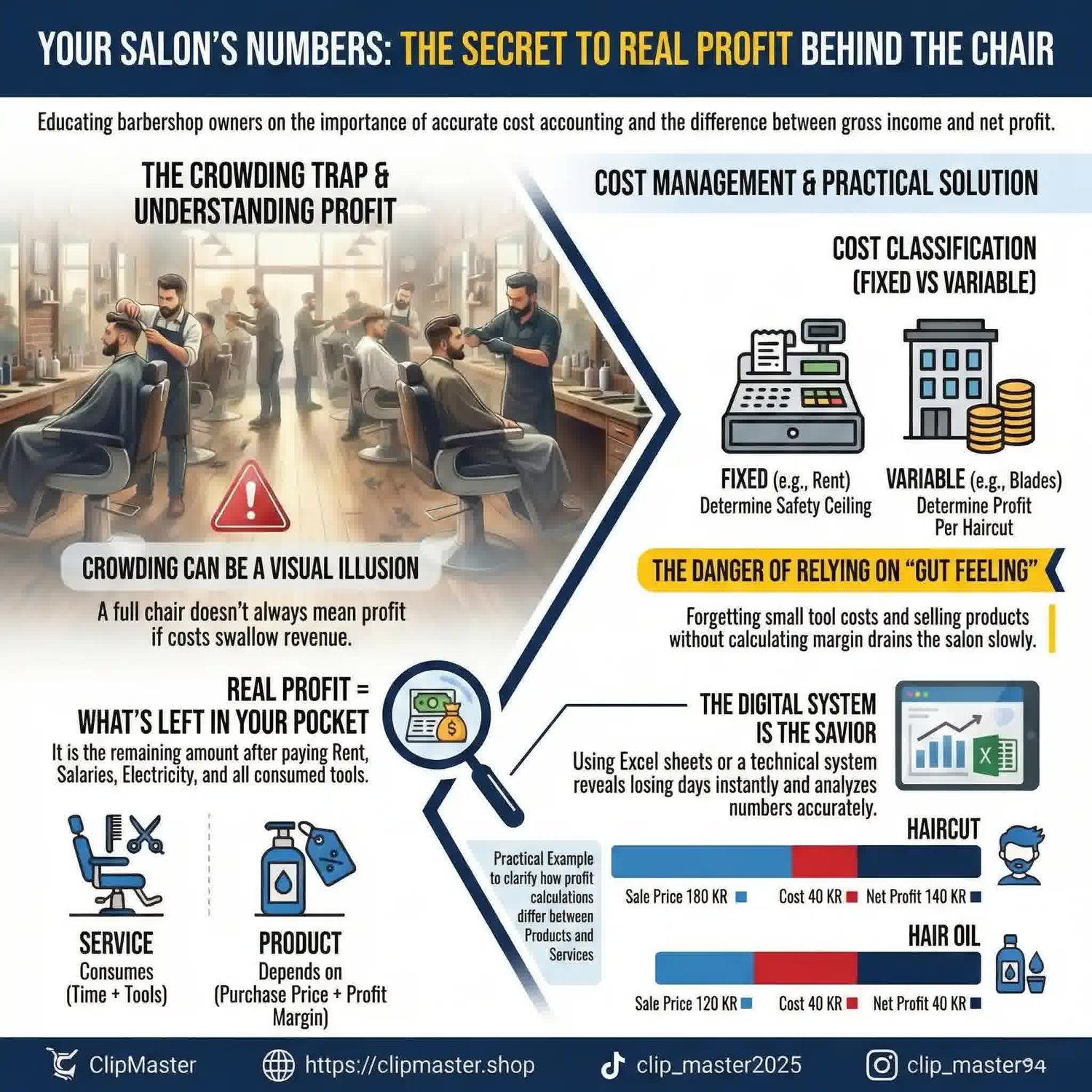
If your barbershop is busy all day, the chair never cools down, yet at the end of the month you feel exhausted with little to show for it, the problem isn’t your skills or a lack of clients.
The real problem is something more dangerous: poor financial management.
Many barbers work harder than ever, but their profits never reflect that effort because they fall into the most common trap in this industry: the busyness trap.
First: Being Busy Does Not Mean You Are Profitable
A full shop and waiting clients feel like success, but this image can be misleading. Busyness means money is coming in, but it does not mean money is staying.
If operating costs consume most of your revenue, you are working more just to earn less, often without realizing it.
A full chair creates revenue, but only smart management creates profit.
Second: Money Never Disappears, It Just Goes Where You Don’t Track It
Every barbershop has two types of expenses.
Fixed costs, such as rent and base salaries, do not care how many clients you serve. They are paid no matter what and represent a constant monthly pressure.
Variable costs increase with every service you provide, including tools, products, and utilities.
The mistake many owners make is focusing on income while ignoring these costs, only to discover later that their profits have been leaking away through small, daily expenses.
Third: Managing by Feeling Is a Direct Path to Loss
Running your finances based on intuition is one of the most dangerous habits.
Failing to calculate the real cost of each service, ignoring daily tool consumption, or pricing retail products without knowing the true profit margin may seem minor, but over time these decisions slowly drain the business.
A barbershop rarely collapses suddenly; it bleeds quietly.
Fourth: Real Profit Is Not What You Think
Profit is not the amount the client pays at the counter. It is what remains after all visible and hidden costs are deducted.
Services like haircuts rely on time and skill, with relatively low material costs, which means their profit margins can be high when managed correctly.
Retail products, on the other hand, depend on purchase price and market competition. Their margins are often lower, and a small pricing mistake can turn a sale into a burden rather than a gain.
Fifth: Numbers Don’t Lie, Systems Decide
Relying on memory or pen and paper is no longer enough in a competitive market.
Digital systems give you a clear picture of your business, reveal loss-making days, highlight your most profitable services, and present numbers that cannot be ignored or justified away.
When you see the numbers clearly, your decisions change automatically.
Conclusion
The difference between a struggling barbershop and a successful one is not the number of clients, but how money is managed.
When you stop chasing busyness and start managing numbers with awareness, you will realize that real profit was never far away. It was always hidden behind the chair.
التعليقات ()